

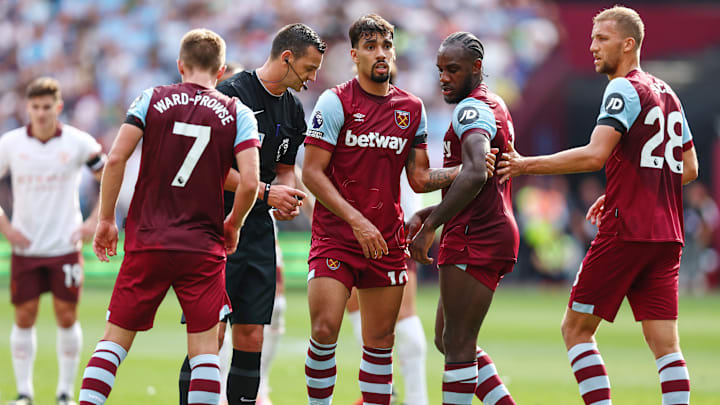
Squad depth isn't just a luxury—it's a necessity. For West Ham United, however, it's becoming a glaring vulnerability that could see them sputtering to a halt as the campaign wears on. The Hammers' recent goalless draw against Bournemouth at the London Stadium on Saturday, encapsulated this issue perfectly, with midfielder Tomas Soucek thrust into an unfamiliar attacking role, highlighting the club's precarious reliance on makeshift solutions. Now we know why manager Nuno Espirito Santo fought so hard to keep Lucas Paqueta. It wasn't just his ability he needed, it was the body.
West Ham entered Saturday's match desperate for points in their battle against relegation, now sitting just two points above the drop zone. Facing a mid-table Bournemouth side, the Hammers dominated possession and created chances but failed to convert, settling for a frustrating 0-0 stalemate. Nuno's side squandered opportunities, with Crysencio Summerville shining as the standout performer, yet the team's overall profligacy left fans lamenting.
Where Nuno gambled most was in the attacking midfield where the Czech international, typically a robust defensive midfielder known for his aerial prowess and tireless work rate, was deployed in the No. 10 position—an advanced playmaking role more suited to creative technicians. Former manager David Moyes once made comparisons to Marouane Fellaini during his Everton days, where the Belgian was used as a target man in attacking areas, but Soucek looked uncomfortable and ineffective. He managed a few blocked shots and was involved in build-up play, but his substitution in the 72nd minute for striker Callum Wilson underscored the experiment's shortcomings. Ratings from the game pegged him at a modest 6/10, noting he appeared "lost in no-man's land" at times.
This Was Not Nuno's Plan
With Freddie Potts serving a 3 game ban for his red card in the FA Cup tie versus Burton Albion, Nuno was forced to reasses his midfield. With Potts and Soucek both healthy Nuno can keep them back and move Fernandes forward, but for this match against the Cherries, Nuno need to be certain to keep more possession in midfield and that meant moving Soucek forward. This wasn't how he invisioned it. Paqueta should still be West Ham's number 10, with Taty upfront and a healthy Pablo Felipe coming off the bench finishing games. Paqueta's departure forced Nuno to give Pablo a heavy workload, one he was not ready for. Against Burnley, Pablo reaggravated a calf injury that had followed him from a match in late December while at Gil Vicente. Sources confirmed that Nuno made the decision to play Pablo despite knowing there was a risk. The squad's medical staff see this as a 4-6 week absence making it possibly late March for a return.
This positional switch for Soucek wasn't a tactical masterstroke; it was a symptom of deeper problems. With injuries and suspensions plaguing the squad, Nuno had little choice but to improvise. Soucek's deployment forward left gaps in midfield, contributing to West Ham's inability to break down Bournemouth's defense despite 16 shot attempts in the second half alone.
The Broader Depth Dilemma
West Ham's issues extend far beyond one match. As the 2025/26 season has unfolded, the club's lack of quality backups has been exposed repeatedly. A squad audit earlier in the campaign highlighted the need for then head of recruitment Kyle Macaulay and then-manager Graham Potter (before Nuno's appointment) to address imbalances, particularly in midfield and attack. Signings like Mateus Fernandes, Igor Julio on loan, Kyle Walker-Peters, Jean-Clair Todibo, and goalkeeper Mads Hermansen bolstered the roster on paper. A January transfer window saw West Ham remove almost every abled body on the bench. Gone were James Ward Prowse, Guido Rodriguez, Luis Guilherme, Paqueta and youngsters George Earthy and Callum Marshall sent away on loan. Those moves have stretched resources thin.
In a December draw against Brighton, four academy players were fielded simultaneously, a clear sign of desperation rather than youth integration. This over-reliance on inexperienced talents or repositioned veterans like Soucek increases the risk of fatigue, especially in a congested fixture list that includes a potential cup run.
It happened again against Bournemouth. Soungoutou Magassa was gassed way before the time he subbed out for Mohamadou Kanté, a 19 year-old who was recently called up to the first team. Credit to Kanté, he played a great final 10 minutes. A more experienced player or a deeper bench might have meant a much earlier sub. This was also a match when Nuno chose not to play Adama Traore, when it was clear Bowen was gassed. Again with no other choices, Nuno felt Bowen needed to the finish the match.
POSITION | KEY PLAYERS | DEPTH CONCERNS |
|---|---|---|
Goalkeeper | Mads Hermansen | Probably the only position on the squad that has cover, but Mads and Alphone Areola are backups on most teams. |
Defense | Konstantinos Mavropanos, Axel Disasi, Aaron Wan-Bissaka, Jean-Clair Tidbo, El Hadji Malick Diouf. | Disasi's arrival means the Centerback position now has depth that doesn't rely on Max Kilman, who has been a disappointment and the academy's Ezra Mayers. |
Midfield | Tomas Soucek, Mateus Fernandes | A January transfer window exodus of midfielders now leaves the position thin. |
Attack | Jared Bowen, Crysencio Summerville, Taty Castellanos | With Pablo out a considerable amount of time, Callum Wilson will have to provide cover, but his form dips highlight a need for more firepower |
Running on Fumes: The Road Ahead
West Ham's depth woes could prove catastrophic and at this point there are no reserves coming. The Premier League's relentless pace demands rotation to maintain performance levels, yet the Hammers' bench often lacks the spark to influence games. Predictions at the season's start placed them in mid-table contention, buoyed by new arrivals, but reality has bitten hard. Now mired in a relegation scrap, the risk of "running out of gas" looms large, particularly as tougher fixtures against top sides approach.
Nuno must navigate this carefully. Calls for strategic reinvestment rather than asset stripping suggest the board's approach is under scrutiny. Soucek's Bournemouth outing serves as a cautionary tale: versatility is valuable, but forcing square pegs into round holes only hastens exhaustion.
 Add us as a preferred source on Google