

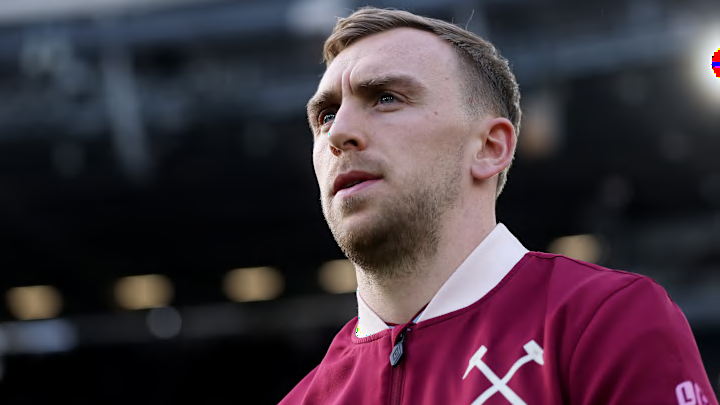
The Hammers are fighting for survival under head coach Nuno Espírito Santo. At the heart of their attack — and their identity — is club captain Jarrod Bowen. The 29-year-old England International has delivered 8 goals and 4 assists in 28 Premier League appearances this season. Respectable numbers for most, but for a player who hit 13 goals and 8 assists last term and who many see as West Ham’s talisman, it feels like a dip. Your eyes tell you something's wrong just by watching him.
Recent weeks have amplified the scrutiny. A section of fans have even questioned whether the captaincy armband is weighing him down, while analysts point to an increased defensive workload that has blunted his trademark runs and clinical finishing. Bowen remains tireless, pressing high and tracking back, but the final-third spark that made him a modern Hammers legend has flickered.
Is he injured? Is he a step slower? Has the mileage on his legs finally caught up to him? There's no question Bowen exerts more energy than most players. That is the job as a wing player; the captain has made his career on running up and down the pitch. "At this point in the season, everyone is in the training room experiencing something," a team source with knowledge of West Ham's medical staff. "He's no different. Someone like [Bowen] potentially has knocks all over his body. It's a choice some players make. Some of them admit that one knock is more severe than others. Some of them know if they give something too much attention it may affect playing time. And he never asks off the pitch. He wouldn't compromise himself so that decision would be made for him either."
""Bowen is captain because he's one of the lads that does have the mental capacity to captain this squad and someone who wants the responsibility.""Team Source
The source added that this time of year there's a mental exhaustion at play as well. "We laugh when we hear the mental burden of being captain weighs on him, but that is why Bowen is captain, because he's one of the lads that does have the mental capacity to captain this squad and someone who wants the responsibility. So there's mental exhaustion, but being a leader has nothing to do with it.
What else is bother Bowen?
Pablo Felipe has been a missing piece that briefly unlocked everything. In early January, West Ham signed 22-year-old Brazilian striker Pablo Felipe from Gil Vicente for around €20 million. The powerful, mobile forward arrived with a glowing record — 10 goals in just 13 league games in Portugal — and immediately brought something the club had lacked: a proper focal point. The attention on Pablo, who absolutely changed the pace of their offensive attack, allowed West Ham's wings more space to operate.
Pablo’s strengths were obvious from minute one: relentless pressing, excellent hold-up play, aerial dominance, and intelligent movement that dragged defenders out of position. In his six appearances (four starts, 328 minutes), he scored zero goals and registered zero assists — yet his impact was transformative. With Pablo leading the line, West Ham looked a different side. They won three of the five Premier League games he featured in, scoring 10 goals and conceding five. Crysencio Summerville exploded into form (scoring in five straight games at one point) and Bowen enjoyed a purple patch with goal involvements in three of four league outings around that period — including a goal at Chelsea and contributions against Manchester United and Sunderland.
Tactically, Pablo allowed Nuno to deploy a fluid 4-4-2 or 4-4-1-1 shape. The young Brazilian occupied centre-backs, created space for Bowen to cut inside from the right onto his left foot, and gave the midfield options to play forward quickly. Pablo didn’t just add goals — he added structure, energy, and breathing room for West Ham’s wide attackers.
Pablo picked up a calf injury in mid-February, which is expected to sideline him for four to six weeks. As of early March 2026, he remains out, training individually and still not ready for full sessions. The numbers since his absence tell the story: three games, zero wins (two draws, one loss), just two goals scored, six conceded. West Ham have reverted to a lone-striker system with Valentin Castellanos or occasional cameos from Callum Wilson. Neither has replicated Pablo’s blend of physicality and pressing intensity.
Without that central anchor, Bowen’s role has subtly shifted — and not for the better. He has shouldered more responsibility: dropping deeper to link play, pressing from wider areas without the same support, and covering for a team that looks less compact defensively. One recent analysis noted that Bowen’s “defensive workload has blunted his attacking edge.” In a heavy defeat at Liverpool and other tough fixtures, he has been asked to do the work of two players.
Position change?
This brings us to the tactical question many Hammers fans and pundits are now asking: should Jarrod Bowen be deployed as a central striker, at least while Pablo is sidelined — or even longer-term? The case for yes is strong:
• Reduced defensive burden. As a right winger, Bowen is expected to track opposing full-backs and wingers for 90 minutes. As a No. 9, those duties largely disappear. He could conserve energy for what he does best: explosive runs in behind, clever movement in the box, and clinical finishing with either foot.
• Proven versatility. Bowen has played up top before and looked dangerous. His pace, work rate, and ability to link with wide players (Summerville on the left, anyone on the right) make him a modern centre-forward in the mould of players like Diogo Jota or even a fitter version of past West Ham loanees.
• Current necessity. With Pablo out and the striker cupboard thin, moving Bowen central could restore the “two-forward” feel that worked so well with Pablo and Taty. It would also allow Nuno to field an extra midfielder or more attacking wide option without losing goal threat.
Cons for Changing Position
• Bowen’s best Premier League seasons have come from the right, where his width, crossing, and ability to cut inside create constant 1v1 dilemmas. Removing that dimension narrows West Ham’s attack.
• The team still needs his high pressing from wide areas to trigger transitions.
• Long-term, the ideal setup may be Pablo (or a similar target man) up top with Bowen and Summerville flanking — exactly the system that briefly flourished in January/February.
Pablo Felipe’s calf injury has exposed just how important the young Brazilian had become in a very short time — and how interdependent West Ham’s attack has grown. Bowen is not “out of form” in the classical sense; he is a victim of circumstance, carrying extra load in a side that has lost its focal point.
Moving Bowen to striker temporarily makes tactical sense while Pablo recovers. It could reignite his goal-scoring streak, ease the defensive toll, and give West Ham a fighting chance in their survival scrap. Once Pablo returns, Nuno should look to restore the partnership that briefly made the Hammers look like a coherent attacking unit.
Bowen remains West Ham’s heartbeat — tireless, committed, and still capable of match-winning moments. The captaincy debate is a distraction; the real issue is system and support. Get the structure right, get Pablo back fit, and the old Bowen will reappear. Until then, a central role might just be the short-term fix the club desperately needs. The season may depend on it.
 Add us as a preferred source on Google