

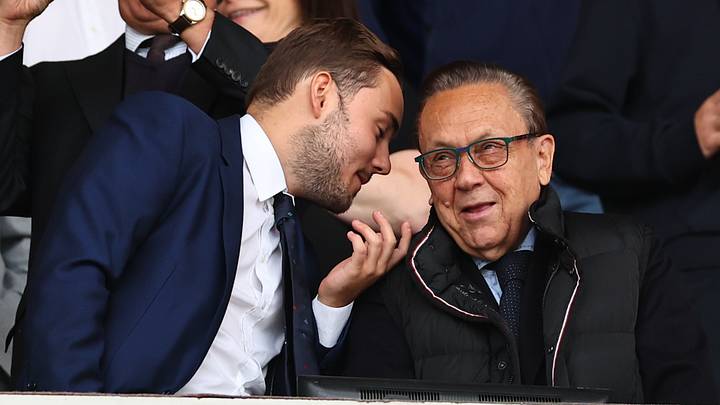
When David Sullivan resigned as West Ham United's joint chairman on Saturday, one question immediately dominated the conversations of supporters, insiders and journalists alike: would he simply be replaced in the boardroom by his sons? Would the Sullivan era continue by another name, with Jack and Dave stepping into the vacuum left by their father?
The answer, delivered swiftly and unambiguously by a club insider, is no.
"Both Dave and Jack have their own businesses, which they wish to focus their time on and will not be following in their father's footsteps," reported ExWHUEmployee, one of the most reliable sources on West Ham's internal affairs. "The club intends to announce soon what the direction of the club will be, with rumours that Daniel Křetínský could be looking to increase his ownership share."
West Ham have officially confirmed the new board structure, and those who were against the prospect of a Sullivan succession will be satisfied — there is no mention of Dave or Jack in the new setup. The Sullivan family's grip on the club they have shaped, for better and for worse, since 2010 has been loosened. The dynasty is over. And in its place, the unmistakable shape of a Křetínský takeover is coming into focus.
The fears were understandable. Sullivan senior, despite resigning from the board and stepping down as a director of both WH Holding Limited and West Ham United FC, retains his 38.8 per cent majority stake in the club. That shareholding does not disappear with his resignation. And both Jack and Dave Sullivan hold positions within WH Holding Ltd, the parent company — meaning the family's structural influence at the club remained a live concern even after the resignation announcement.
Jack Sullivan is no stranger to the corridors of the London Stadium. Appointed by his father to the role of managing director of West Ham United Women at just 17, he became the youngest executive in English football history and oversaw the women's team's rise to the Women's Super League. He later returned to the club as a director. Dave Sullivan, David's elder son, has similarly held a seat at the board table. Between them, they represented a plausible mechanism through which Sullivan senior could have retained de facto influence over the club he built.
Speculation was rife in the immediate aftermath of the resignation that Sullivan would pass on control of his shares to his two sons, keeping the family's influence alive in the boardroom while giving the appearance of change. The news that this is not the plan came as a surprise to many who had assumed the cynical outcome.
The confirmation is significant not just practically, but symbolically. It signals that this is a genuine rupture — not a reshuffling of the same deck. The Sullivans are out, in name and in boardroom presence. What replaces them is something categorically different.
Křetínský's Masterplan: The Full Buyout
Křetínský is said to be "keen" to buy out the Sullivans, as he does not like the idea of Jack and Dave replacing their father. His leaked masterplan includes a £90 million cash injection, buying out the Sullivan family entirely, and acquiring The London Stadium.
The Czech billionaire has been building toward this moment since he first acquired 27 per cent of the club in November 2021. He is famed for his penchant for buying distressed assets on the cheap — and a West Ham United whose enterprise value has likely halved overnight following relegation would seem to fit the bill precisely. For a man of Křetínský's financial firepower — his personal wealth has been reported at around £8.31 billion, making him the 300th richest person in the world, while his company Energetický a Průmyslový Holding holds assets worth £23.45 billion — buying out a distressed majority stakeholder in a relegated football club is not a stretch. It is an opportunity.
There is, however, an intriguing wildcard in the mix. As reported first by Hammers News, Amanda Staveley — the mega-rich financier famed for her role in game-changing takeovers at Manchester City and Newcastle United — remains interested and is waiting to pounce should Sullivan's stake come to market. Whether Křetínský moves first, or whether Staveley forces a competitive process for Sullivan's 38.8 per cent, will be among the most consequential questions in West Ham's immediate future.
Could the Allegations Force Sullivan's Hand?
It is impossible to discuss the future of David Sullivan's shareholding without confronting the question that hangs over everything: what impact will the incoming allegations have on his legal ability to retain ownership of West Ham United?
Sullivan resigned from the board citing his need to fight what he describes as false and fabricated claims connected to his history in the adult entertainment industry. He has engaged legal counsel and vowed to pursue proceedings. But resigning as a director and selling shares are two entirely different things — and the question of whether the Premier League's own rules could ultimately compel the latter is one that football's governing framework makes increasingly relevant.
The Premier League's Owners' and Directors' Test (OADT) is the regulatory mechanism designed to determine who is fit to own or control a top-flight club. Following a comprehensive reform in 2023, the test was significantly strengthened. The list of criminal offences resulting in disqualification was extended to include offences involving violence, corruption, fraud, tax evasion, and hate crimes. Crucially, the Premier League also introduced a new power to stop those under investigation for conduct that would result in a disqualifying event if proven.
This "Potential Disqualifying Event" provision would essentially prohibit someone from being an owner or director of a club where they are the subject of an ongoing investigation by a UK criminal authority — or any equivalent body of competent jurisdiction anywhere in the world — for conduct which, if proven, would result in a disqualifying event.
Sullivan's 38.8 percent is well above the 25 percent threshold at which the OADT applies. He has stepped down from the board, but he remains a controlling shareholder. Under the reformed rules, the threshold for "control" was specifically lowered from 30 percent to 25 percent, precisely to close the loophole of significant shareholders escaping scrutiny by remaining off the board.
The critical distinction is this: Sullivan has not been charged, let alone convicted, of anything. He denies all allegations. And the OADT, as it stands, is not triggered merely by allegations or the threat of publication. But should formal investigations be opened by UK criminal authorities, the "Potential Disqualifying Event" clause comes into active consideration — and the Premier League would have both the standing and the regulatory machinery to review his ownership position.
Furthermore, the Premier League's Independent Oversight Panel, now chaired by Sir Gary Hickinbottom following his appointment in March 2026, holds the power to review determinations of the board in respect of whether incumbent owners are liable to be disqualified and whether proposed changes of control should be approved. The IOP is not a passive body. It has teeth, and it now has cause to watch the Sullivan situation closely.
In short: if the allegations result in a formal criminal investigation, Sullivan may find that the Premier League's regulatory framework — not just public pressure — accelerates the question of whether he can continue to hold a majority stake in a professional football club.
The Power Shift Is Complete in Everything But Name
With or without the legal pressure, the direction of travel at West Ham is unmistakable. The Sullivan era has ended not with a transition, but with a clean break. The sons who might have preserved a family dynasty have chosen their own paths. The board that has been confirmed contains no Sullivan presence. And the man now circling to buy the departed chairman's stake is the same man who has spent five years watching, waiting and being held back.
Křetínský's masterplan, as leaked by multiple sources, including GSH, starts with a £90 million cash injection to balance the club's books by the end of June, the buying out of the Sullivan family entirely, and the acquisition of the London Stadium. It is, in other words, not just a change of leadership — it is the foundation of a complete reimagining of what West Ham United is and how it operates.
The Sullivans are gone. The dynasty is over. And the Czech billionaire who always told to those close to him that he wanted full control is finally, irrevocably, getting it.
NOTE: David Sullivan denies all allegations of improper conduct and has stated his legal team is preparing to contest every complaint made against him. He has not been charged with any criminal offence.
 Add us as a preferred source on Google