

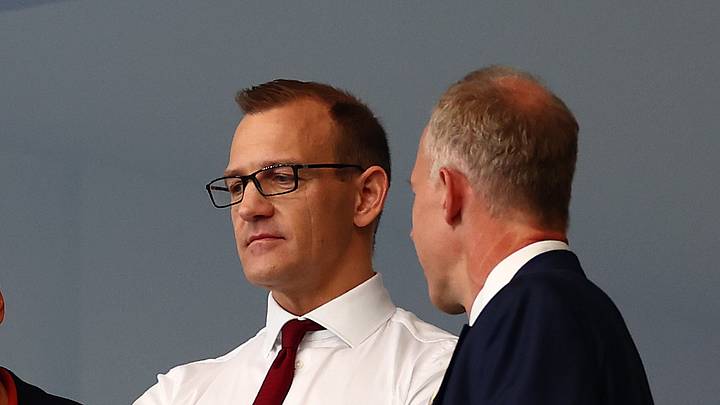
The potential departure of Maximilian Hahn from West Ham United's front office might not make headlines in the way a player exit would. But make no mistake — if the club's Head of Technical Recruitment and Analysis walks out the door this summer, it will be another unmistakable signal of something far bigger happening behind the scenes at the London Stadium. David Sullivan is losing his grip, and the people now steering this club are Interim CEO Karim Virani and majority shareholder Daniel Křetínský.
Hahn is officially being headhunted, with a number of clubs in Germany — including Schalke — identifying him as a candidate for a Sporting Director role. Southampton and Blackburn Rovers are also understood to be keen on the highly-rated transfer specialist. For a 30-year-old who holds an important position at West Ham as head of technical recruitment and analysis, with a likely significant say in West Ham transfers, the interest is entirely understandable. What is less understandable is why West Ham appears powerless to stop it.
Hahn's contract runs until the 30th of June 2026, meaning the club is staring at the very real possibility of losing one of their key football operations figures for free, at the precise moment they need experienced, analytically-minded staff to help rebuild a squad for a Championship promotion campaign. The timing could not be worse.
To understand why Hahn's situation matters beyond his individual role, you need to understand where he came from. Hahn was appointed in his current West Ham role in early 2024, with that appointment being made under Tim Steidten's watch. Steidten, of course, is long gone — another casualty of the chaos that has defined this club's football operations over the past two years. Hahn survived that transition, but the changing of the guard now happening at the board level may prove a more difficult environment to navigate.
He is, in essence, a remnant of a previous football structure — one that Sullivan's ownership helped create and then dismantled. In a new West Ham being shaped by different hands, there is every reason to question whether Hahn sees his long-term future at the London Stadium, regardless of what division the club is playing in.
Sullivan Has Lost the Room
The broader context here is damning for Sullivan. West Ham moved swiftly to fill the leadership vacuum left by Baroness Karren Brady's shock departure, announcing the appointment of Karim Virani as the club's new interim Chief Executive Officer on 29 April 2026. Brady had been Sullivan's most trusted lieutenant for 16 years. Her departure didn't just leave a vacancy — it left a void at the very heart of his influence over the club. Brady was Sullivan's bulldog. Without her, he doesn't have any bite.
Virani was officially unveiled as the new chief executive, with the official West Ham United website describing him as "a highly respected and experienced figure within the professional game." He is not Sullivan's man in any meaningful sense. He previously worked for West Ham between 2015 and 2020, leading the digital, marketing and commercial operations, before stints elsewhere, and his return has been embraced most enthusiastically by those in the Křetínský camp.
The decision to retain Nuno Espírito Santo — which Sullivan was reportedly against — was one thing. But the appointment of Virani, combined with the possible loss of Hahn, paints a consistent picture: the decisions being made at West Ham right now are not Sullivan's decisions. Sullivan and Křetínský have reportedly discussed potentially purchasing shares from Vanessa Gold to become equal partners, indicating a possible shift in the club's governance structure in the near future. That shift, it appears, is already well underway in practice, even if it has yet to be formalised on paper.
What It Means for the Rebuild
West Ham are about to embark on one of the most consequential summers in their recent history. They need to overhaul a squad, work within the financial constraints of Championship football, and identify players capable of mounting an immediate promotion challenge. Losing the man responsible for technical recruitment and analysis at that exact moment would be a serious blow — not just operationally, but symbolically.
It raises a fundamental question about who is actually running the football side of this club. With Hahn potentially gone, no permanent CEO in place beyond an interim appointment, and the manager himself only retained due to circumstance rather than conviction, West Ham head into the Championship rebuild with a leadership structure that remains dangerously unclear.
Sullivan built this club in his own image for over a decade. For better or worse, there was always a clear decision-maker at the top. That clarity is gone. And until Křetínský, Virani, and whoever replaces Hahn — if he does indeed leave — establish a coherent new structure, West Ham will be navigating one of the most important summers in their history without a steady hand at the wheel.
Křetínský has become The Dark Knight
Fans may not approve of Křetínský's tactics, but taking a step back and looking at his time as a minority owner at West Ham, his plan, it seems, was to wait everyone out. First, the death of David Gold, then the demise of the club, Brady becoming the sacrificial lamb to satisfy the fan base that "change" was on the way, and finally, the relegation of the team. All of that has opened a clear path for Křetínský to be given more influence.
Any fan would look at the way Křetínský has moved and wonder why he wouldn't stop the bleeding before it got worse. Sources close to the European Billionaire have admitted he wouldn't invest more of his money into a team that Sullivan has full control over. Instead, he waited for Sullivan to bottom out. It makes him unconventional. It also makes his actions unpredictable. Dare we say it, it makes him East London's Dark Knight.
 Add us as a preferred source on Google