

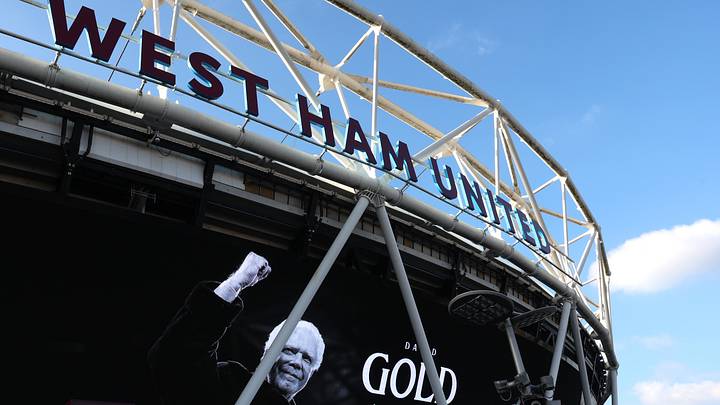
West Ham United's ownership crisis arrived in two waves. The first, last week, was the abrupt resignation of David Sullivan as joint-chairman — a man who had controlled the club for sixteen years — announced in a terse club statement citing "serious historic allegations" made aware to him ahead of their imminent publication. The second wave came today, with a joint statement from Vanessa Gold and Daniel Křetínský that simultaneously addressed those allegations and fundamentally restructured the club's power architecture.
The statement does what good crisis communications rarely manage: it answers the question nobody in football governance usually wants to touch directly. It tells us what the board knew, what it didn't know, and what it is now doing about it. It also confirms what had long been speculated — that Křetínský's Czech holding vehicle, 1890 Holdings, part of the broader EP group, is poised to become the dominant force at London Stadium.
The detail matters. So does the sequence. Working through the statement line by line reveals both the architecture of the incoming ownership structure and the significant questions it leaves unanswered.
The Sullivan Allegations: What the Statement Says — and What It Implies
Gold and Křetínský open by addressing the BBC Panorama and Times investigation head-on. They describe themselves as "deeply concerned" by the revelations and extend their thoughts to the seven women whose accounts were reported — women who claimed Sullivan engaged in sexually exploitative and predatory behaviour spanning his years building a fortune in the adult entertainment industry. Sullivan has categorically denied those claims.
This passage is careful but loaded. What Gold and Křetínský are establishing — on the record, in a club statement — is that the board did not have prior knowledge of the substance of the allegations. Sullivan, they say, gave the board approximately a month's notice that something "may be published." He did not disclose what. The full details only emerged when the Panorama investigation broadcast on Monday.
There is a secondary disclosure embedded in the same paragraph that may prove more significant: "the Board representatives of shareholders other than David Sullivan were only made aware this week of the safeguarding measures that have been in place since 2023." This sentence deserves close reading. It confirms that West Ham has had safeguarding arrangements in place relating to Sullivan for three years. The rest of the board — Gold, Křetínský, and the minority shareholders — were not informed of those measures until after the investigation went public. Who authorised those measures, and under what governance framework, is not addressed in the statement.
Breaking Down the Share Purchase: What 43% Actually Means
The structural consequences of this crisis follow directly from the governance vacuum Sullivan's departure creates. West Ham needs capital. It has just been relegated. It is operating with an interim CEO. And it now lacks its majority shareholder at the boardroom table. Gold and Křetínský's solution is to consolidate control explicitly.
The transaction being announced is a purchase by 1890 Holdings — Křetínský's vehicle — of the Gold family's shares. Vanessa Gold currently holds approximately 25.1% of the club, inherited from her father David Gold following his death in January 2023. She had previously appointed Rothschild & Co to advise on a sale of those shares in October 2023 — a process that has now, evidently, concluded.
The arithmetic is straightforward: Křetínský buys the Gold family's 25.1%, taking his stake from 27% to approximately 43%, which exceeds Sullivan's 38.8%. For the first time since Sullivan took control of West Ham in 2010, the club would have a majority stakeholder who is not Sullivan — and who, critically, has the aligned coalition of minority shareholders behind him.
The statement is explicit that all remaining shareholders — Smith, Harris and Brown — are "fully aligned on this strategy." This is not incidental. It means Sullivan, even retaining his 38.8% stake, would find himself outvoted on virtually every material decision.
"As such, we have reached agreement on the key terms of a share purchase transaction between the Gold family and 1890 Holdings, which, subject to other Shareholders' pre-emption rights and necessary approvals, would make 1890 Holdings (part of the broader group EP) the largest Shareholder in West Ham with an approximately 43% stake. As the largest Shareholder, group EP will be able to provide the additional financing the Club needs."Gold family and Daniel Křetínský
"Subject to other Shareholders' pre-emption rights."
This is the lawyerly hedge that contains a real structural consideration. Pre-emption rights — standard in closely-held company structures — give existing shareholders the right of first refusal to purchase shares being sold, proportionate to their existing holdings. Sullivan, as the largest current shareholder, would have the most significant pre-emption entitlement. If he exercised those rights in full, he could block Křetínský from acquiring Vanessa Gold's stake. The statement's use of "subject to" rather than "having waived" or "pre-emption rights having lapsed" suggests this has not yet been resolved. Whether Sullivan exercises or waives his pre-emption rights may be the most consequential decision the coming weeks produce.
"Part of the broader group EP."
The statement is careful to situate 1890 Holdings within Křetínský's broader European portfolio — EP Group, which spans media, energy, and industrial holdings across the Czech Republic and Western Europe. This framing is deliberate: it positions the incoming majority shareholder not as a speculative buyer but as a structured, well-capitalised corporate entity capable of providing what comes next.
"Group EP will be able to provide the additional financing the Club needs."
This is the most commercially significant line in the statement, and it lands without elaboration. What financing? How much? On what terms? The statement does not say. What it does signal is that West Ham's immediate financial position — navigating the Championship with a Premier League wage bill, a relegated squad, and a looming summer transfer window — requires external capital injection that neither Sullivan nor the existing board configuration could deliver. Křetínský's elevation to majority shareholder is being sold, in part, as the unlock for that funding.
What Comes Next
Gold and Křetínský are explicit about their football strategy: retain key players, back Nuno Espírito Santo's management, and target an immediate return to the Premier League. The framing of "the strategy targeting an immediate return" sets expectations while also hemming in the new majority ownership coalition from day one. There will be no grace period if the Championship campaign falters.
Crucially, the Gold family are not simply cashing out. The statement confirms that post-transaction, the Golds and 1890 Holdings have agreed to vote jointly on key matters. This is a shareholder coalition arrangement — a voting bloc that, combined with the support of Smith, Harris and Brown, would give the Křetínský-led alliance decisive control over the club regardless of Sullivan's residual stake.
Sullivan's position in this new configuration is genuinely precarious. He resigned as director and joint-chairman last week. He retains 38.8% of the shares. But with his allies selling to Křetínský and the minority shareholders aligned against him, he faces the prospect of being the club's second-largest shareholder with no board representation, no operational role, and a governance structure actively designed to function without him. Whether he attempts to sell his stake — and to whom — will be one of the defining questions of West Ham's next chapter.
For all the forward-looking language about stabilisation and promotion, the statement carries within it an implicit admission that the club's governance failed. The safeguarding measures "in place since 2023" — the existence of which board members say they learned about only this week — suggest a parallel structure operated by or around Sullivan that sat outside normal board oversight. That is a serious institutional concern, and it is one that neither Gold nor Křetínský directly addresses in terms of accountability or remedy.
The statement says the board's focus is now "firmly on protecting the future of this football club." That is the appropriate priority. But protecting the future also requires confronting the past more directly than a carefully calibrated public statement allows. The governance audit that West Ham's institutional credibility now demands — who knew what about Sullivan, when, and what powers authorised the safeguarding arrangements implemented three years ago — will need answers that go beyond a joint press release.
For now, the statement achieves its primary objectives: it distances the incoming ownership bloc from Sullivan's conduct, establishes the broad terms of a power transfer, and signals financial intent. The transaction, the statement says, should finalise within "the next couple of weeks." Whether it does — and whether Sullivan exercises his pre-emption rights to complicate that timetable — will determine how cleanly West Ham can enter the Championship under genuinely new leadership.
 Add us as a preferred source on Google