

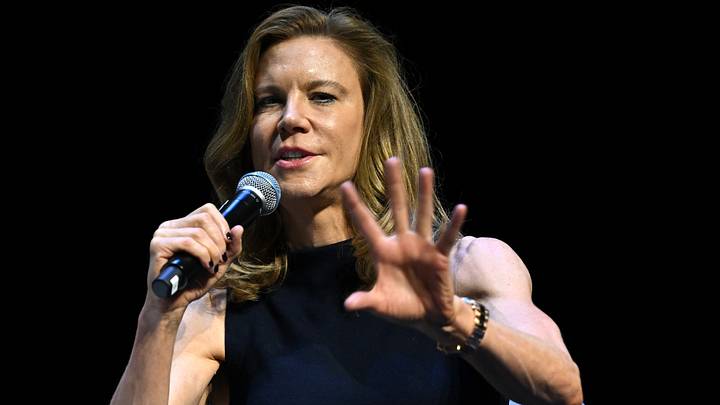
What started as a fairly straightforward share sale has turned into the most consequential ownership battle West Ham have faced since the David Sullivan/David Gold era began, and by the time the dust settled this week, Daniel Křetínský had emerged with control of the club; Amanda Staveley, on the surface, looks like she is being shut out entirely. But by putting herself on display at The London Stadium on Tuesday, she’s up to something, or David Sullivan has quietly cemented his position and is looking to regain power.
As reported on GSH in June, Staveley's interest in West Ham didn't begin with the Gold family shares at all. Her first move was a direct approach to Křetínský about coming in as an equal partner alongside him. That approach was rebuffed. Only after being turned down did Staveley pivot to the shares Křetínský had already been in the process of agreeing to buy from Vanessa Gold, striking her own £150 million deal with the Gold family in July for their 25.1% stake, a valuation that put the whole club at roughly £600m. Bloomberg News confirmed the shape of that arrangement, reporting Staveley's PCP Capital Partners, working alongside Chicago-based Ashland Forest Capital Partners, had agreed to take the 25.1% Gold shareholding in a deal that set up a direct clash with Křetínský over control of the club.
Round 1: Everyone takes a slice
Under West Ham's pre-emption structure, any external sale has to first be offered to existing shareholders pro rata before an outside buyer like Staveley can complete a deal. That process seems to have worked against her. Every existing shareholder exercised their round-one rights to buy a slice of Gold's 25.1%, which meant there was nothing left in round two, and Staveley was locked out entirely.
The approximate figures from that round: Sullivan bought 51.8% of the available 25.1% (roughly 13% of the club) for about £77 million. Křetínský bought 36.0% of it (around 9%) for roughly £54 million. Tripp Smith took 10.68% of it (about 2.68%) for around £16 million. Terry Brown and Daniel Harris combined for 1.52% of it (roughly 0.42%) for about £2.3 million. All told, that's £149.3 million spent on 25.1% of a club valued at £594.8 million. Those are numbers that track closely with Bloomberg's independently reported £150 million/£600 million figures for the original Staveley-Gold agreement.
After round one, the ownership picture looks like this: Sullivan at 51.8% (38.8% plus the newly acquired 13%), Křetínský at 36.0% (27% plus 9%), Gold reduced from 25.1% to zero, Smith at 10.68%, and the remaining shareholders at 1.52%. At that specific moment, Sullivan was the outright majority shareholder of West Ham United.
Round 2: Shareholders Realign Around Křetínský
In the aftermath, the existing shareholders agreed among themselves to redistribute shares in a way that would hand Křetínský majority control instead. Multiple reports have now corroborated this arrangement. The Times' Matt Lawton reported Křetínský moving to a 46% holding, with Sullivan settling at 40% and Tripp Smith rising to 11%, leaving the remaining shareholders with roughly 3% between them. That lines up closely with the reported figures: Sullivan down from 51.8% to 40% (value roughly £237.9m), Křetínský up from 36.0% to 46% (roughly £273.6m), Smith up slightly to 11% (roughly £65.43m), and others up to around 3% (roughly £17.84m). It's worth flagging that the exact final percentages haven't been fully confirmed publicly, and it's still unclear whether Brown and Harris ended up acquiring additional shares directly from Sullivan as part of the rebalancing.
What's not in dispute is the outcome: Daniel Křetínský is now West Ham's majority shareholder. Reporting also suggests Sullivan privately indicated a preference for dealing with Křetínský over Staveley throughout this process, which explains why the existing shareholder group closed ranks the way it did rather than opening the door to an outside buyer.
What now?
As was reported by @ExWHUEmployee earlier today :
— mark carlaw (@markcarlaw) September 1, 2026
Amanda Staveley is at the stadium tonight 👀⚒ pic.twitter.com/M4dfkRtAEC
Staveley was present at the London Stadium for West Ham's 4-2 win over Wolves while all of this was playing out, and reporting has consistently suggested she isn't simply walking away. One well-sourced line of speculation is that she turns her attention to Sullivan's remaining 40% stake directly. There's already been talk of discussions around exactly that scenario, particularly given the Football Regulator's ongoing scrutiny of Sullivan's suitability as a shareholder following the BBC Panorama and Times investigation into him, which makes his long-term position at the club genuinely uncertain regardless of what happens with Staveley.
What makes this scenario seem feasible was a comment she made to her partners. GSH reported on August 3rd that during a conference call with her investors, she proclaimed, “We’re going for all of it.” While it seems like all the current board members are aligned, Sullivan has no loyalty to either Křetínský or Smith, especially after the board seemingly forced former vice-chair Karren Brady out and the board aligned against him, making it impossible for him to have a say in the club’s operations. Staveley could still make offers to the remaining shareholders. That would take her to 54%, but that would also mean she would have to go through the same process. Kretinsky would have the right to buy more shares, blocking her again from a majority stake.
There's also a version of events where this isn't over for a more structural reason: Křetínský deliberately engineered his stake to land at 46% rather than crossing 50%, reportedly because a 2021 shareholder agreement would force him to buy out Sullivan's shares at an inflated price if he passed that threshold. Staying under 50% keeps that clause dormant. It also means Křetínský doesn't have outright, unchallengeable control, which theoretically leaves a door open for further maneuvering down the line, whether from Staveley or another party.
The more skeptical read, and the one some inside the process have floated, is that Staveley is now genuinely isolated. A minority-interested outsider with no shares, no board seat, and no obvious path back in unless one of the two power brokers decides to sell. Whether this is truly the last West Ham sees of her, or simply a pause before she resurfaces around Sullivan's stake. That will most likely become clear over the coming months as the Football Regulator's decision on Sullivan looms and the club's ownership structure faces yet another potential shake-up.
 Add us as a preferred source on Google