

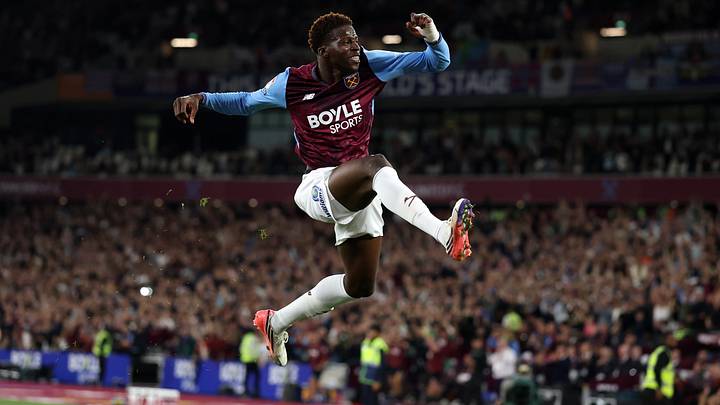
Mohamadou Kanté's development at West Ham has been one of the more interesting storylines so far this season, and the pattern is now hard to ignore: give him space in front of him and a licence to run into it, and he looks like one of the best players on the pitch. Ask him to operate deeper, in a conventional midfield role facing his own goal, and a lot of what makes him dangerous simply disappears.
Kanté's best moments this season have all come with him facing forward, attacking space rather than building play from deep. Against Portsmouth in the Carabao Cup, he turned Regan Poole inside out before rolling the ball across for Castellanos to open the scoring. Against Burnley, he barrelled down the left to tee up Manor Solomon. And in the 6-0 thrashing of Wrexham, he came off the bench and broke the offside trap to latch onto a sublime Manor Solomon ball over the top, controlling it on the run before smashing it past the goalkeeper for West Ham's fifth. Three different moments, three different phases of the season, and the common thread is identical: Kanté with the ball at his feet and grass in front of him.
The flip side of that pattern has been just as visible. Against Charlton earlier in the season, with the visitors sitting deep and inviting West Ham to build patiently, Kanté visibly struggled. The game simply didn't offer him the space to do the thing that makes him effective. It's a small sample, but it lines up with a broader footballing truth about players of his profile: some players create in tight spaces, others need room to accelerate into. Kanté is emphatically the latter.
What makes this even more interesting is how many positions Kanté has already occupied this season without losing that effectiveness. He's played as a wide forward, cutting inside off the flank. He's played as a number ten, operating just behind the striker. He's come on as an out-and-out advanced runner breaking in behind a tiring defence. Each of those roles has produced end product. The one role that hasn't is sitting deeper as a conventional central midfielder, tasked with progressing the ball from base rather than receiving it in transition. From here on out, Nuno should now be actively steering him away from that.
That's a notable shift in thinking for a manager who's used Kanté across multiple slots already this season. Something else to take into consideration: at the Premier League level this season, Nuno wouldn’t have been able to have the patience to find out where Kanté was most effective. In the second tier Nuno can continue to deploy him in multiple forward positions and see in real time how one of his best young players can develop into a weapon in the attack.
Rather than treating Kanté as a squad rotation option for Arne Engels, Lewis Orford or Divine Mukasa, Nuno may get more value out of viewing him as an alternative to Joel Piroe or Castellanos themselves. Right now Nuno has leaned into using Pablo Felipe in that role, and for the most part he’s contributed as a link player. We all know his struggles to get his first goal; Kanté has shown he can be just as effective and contribute more offensively. He’s shown himself as someone who can lead the line, play off a striker, or operate as a wide forward in West Ham's front three, depending on the picture Nuno wants to paint that week. It's an unusual profile for a manager to plan around, but West Ham don't have many players who combine his pace, directness, and finishing instinct once he's facing goal.
With four straight league wins now behind them and Kanté a repeated contributor to that run, Nuno has real evidence in front of him. The question now is whether he trusts that pattern enough to stop treating Kanté as a midfielder who occasionally plays forward, and start treating him as a forward who happens to be capable of playing midfield.
 Add us as a preferred source on Google